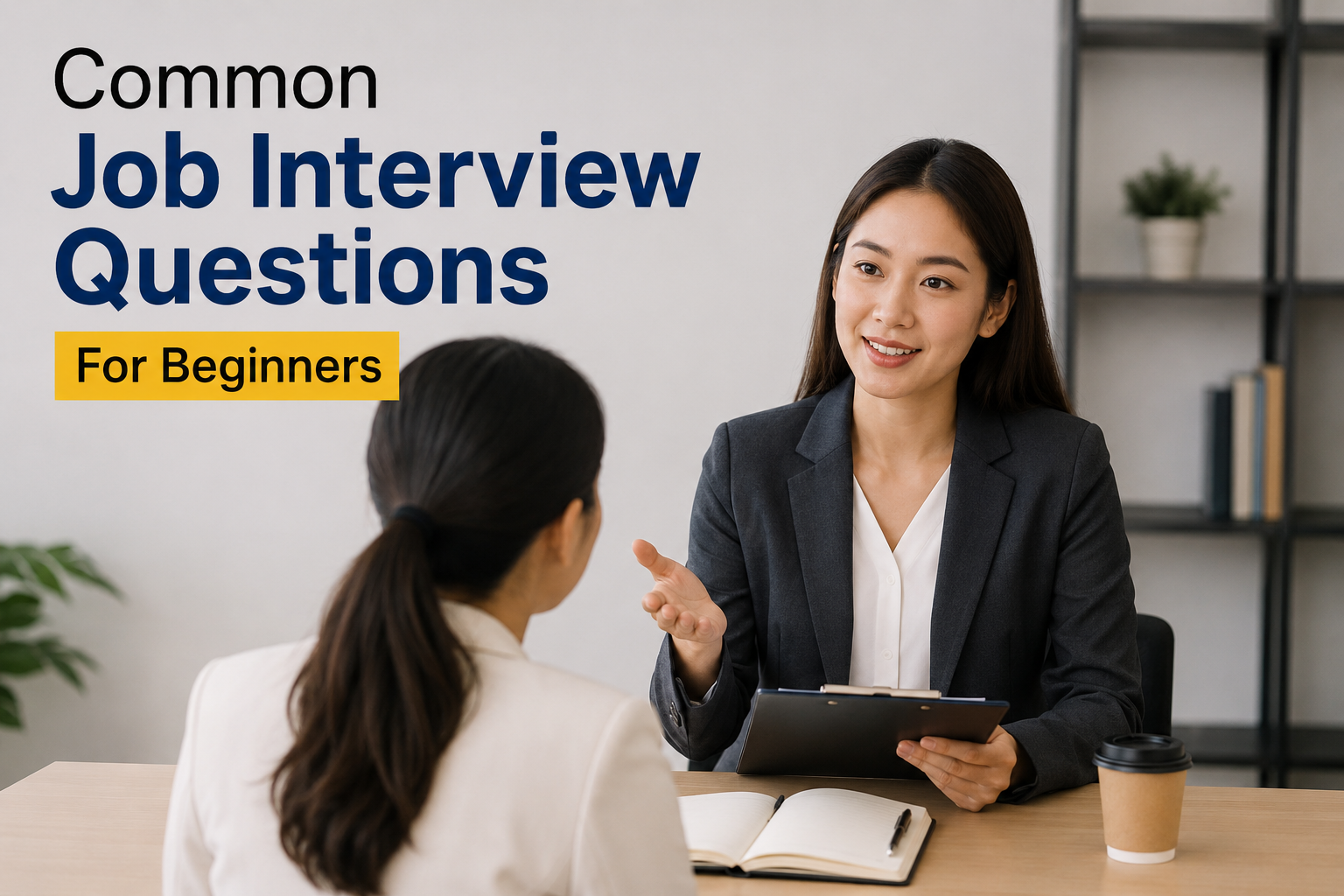
Starting your first job can feel exciting and stressful at the same time. I remember how confusing interviews can seem when you do not know what the interviewer may ask. The good thing is that most beginner job interviews include several common questions that you can prepare for in advance.
In my opinion, preparation is one of the easiest ways to feel more confident during a job interview. You do not need to memorize every answer. Instead, you should understand what the interviewer wants to know and prepare honest answers based on your education, skills, interests, and experience.
If you are preparing for your first job interview, learning about common job interview questions for beginners can give you a useful advantage. In this article, I will explain some of the most common questions, what they mean, and how I would approach answering them.
1. Tell Me About Yourself
This is one of the most common job interview questions for beginners. It often comes at the beginning of an interview, so your answer can create the first impression.
I would keep this answer simple and focused on professional information. You can briefly talk about your education, skills, interests, and why you are interested in the position.
For example, you could say that you recently completed your studies, developed an interest in a particular field, and have been working on improving skills related to the job.
I would avoid sharing too many personal details. The interviewer wants to understand who you are as a potential employee.
2. Why Do You Want This Job?
Interviewers often ask this question because they want to know whether you are genuinely interested in the position.
Before the interview, I recommend researching the company and reading the job description carefully. Then you can connect your interests and skills with the responsibilities of the role.
A good answer should show that you understand what the job involves. Instead of simply saying that you need a job, explain why the position interests you and how it fits your career goals.
3. What Are Your Strengths?
This question gives you an opportunity to talk about qualities that can help you succeed at work.
As a beginner, you may not have years of professional experience, but you probably have useful strengths. These could include communication, organization, teamwork, learning quickly, problem solving, creativity, or time management.
I would choose two or three genuine strengths and give a short example whenever possible.
For example, if you say that you are organized, explain how you manage assignments, projects, or deadlines. A real example makes your answer more believable.
4. What Is Your Biggest Weakness?
Many beginners become nervous when they hear this question. I think the best approach is to be honest while showing that you are working to improve.
Do not say that you have no weaknesses. Everyone has areas that can be improved.
You could mention that you sometimes spend too much time checking your work because you want it to be accurate. Then explain how you are learning to manage your time better.
The important thing is to show self awareness and a willingness to improve.
5. Why Should We Hire You?
This can sound like a difficult question, especially if you are applying for your first job.
I would focus on your attitude, willingness to learn, relevant skills, and ability to contribute to the team.
You do not need to claim that you are better than every other candidate. Instead, explain why your qualities match the position.
For example, you could say that although you are beginning your professional career, you are motivated, responsible, willing to learn, and ready to take your responsibilities seriously.
6. What Do You Know About Our Company?
This is one of the easiest questions to prepare for if you do your research.
Before attending an interview, I would visit the company’s website and learn about its products, services, customers, values, and recent activities.
You do not need to memorize everything. You simply need enough knowledge to show that you are interested.
A candidate who knows basic information about the company usually appears more prepared than someone who knows nothing about it.
7. Why Did You Choose This Career?
This question is usually about your motivation.
Think about what attracted you to your chosen field. Perhaps you enjoyed a particular subject in school or college, developed an interest through personal projects, or discovered that your skills are suitable for the industry.
I would give a natural answer instead of trying to sound overly professional. Interviewers often appreciate genuine explanations.
8. Where Do You See Yourself in Five Years?
Employers ask this question to understand your goals and whether you have thought about your future.
You do not need to predict your entire life. A simple answer about developing your skills, gaining experience, taking on more responsibility, and growing within your career can work well.
I would avoid saying that you expect to become the company’s top executive within a few years. Keep your answer realistic and connected to the job.
9. Do You Have Any Work Experience?
If you are a beginner, do not panic if you do not have formal work experience.
You can talk about internships, volunteer work, university projects, freelance work, part time activities, or personal projects if they are relevant.
For example, if you are applying for a writing position, you could discuss articles or other writing projects you have completed. If you are applying for a technology position, you could mention websites, applications, or other projects you have worked on.
The goal is to show what you can do, even if you have not worked in a traditional office before.
10. How Do You Handle Pressure?
Almost every workplace has deadlines and challenging situations, so employers want to understand how you react under pressure.
I would explain the practical steps you take. For example, you can say that you prioritize tasks, make a schedule, focus on one important task at a time, and communicate when you need clarification.
Try to give a real example from school, college, training, or another situation.
11. Are You a Team Player?
Most jobs require some level of teamwork.
Instead of simply answering yes, explain how you work with others. You can mention listening to different opinions, communicating clearly, completing your responsibilities, and helping teammates when necessary.
If you have completed a group project, it can provide a good example.
12. How Do You Handle Criticism?
Nobody performs perfectly all the time. Employers want people who can accept useful feedback and learn from it.
I believe a strong answer should show that you do not take constructive criticism personally. Instead, you listen carefully, understand what needs improvement, and try to do better.
You can also explain that feedback helps you develop professionally.
13. What Are Your Salary Expectations?
Salary questions can make beginners uncomfortable, but they are common in many job interviews.
I would research the typical salary range for the position and location before the interview. You can then give a reasonable range based on the role, your skills, and the company’s expectations.
If you are unsure, you can also politely ask about the company’s salary range for the position.
14. Why Should We Choose You Without Much Experience?
This question may appear when you are competing with candidates who have more experience.
I would not apologize for being a beginner. Instead, focus on your potential.
Explain that you are ready to learn, accept responsibility, develop new skills, and work hard. Your education and personal projects can also demonstrate your ability.
Sometimes employers are looking for someone with the right attitude and willingness to learn, not just someone with a long resume.
15. Do You Have Any Questions for Us?
This question often comes at the end of the interview.
I strongly recommend preparing a few questions before the interview. Asking thoughtful questions shows that you are interested in the position.
You could ask what a typical day looks like, what skills are most important for the role, how new employees are trained, or what success looks like during the first few months.
I would avoid asking only about salary, holidays, or benefits during the first interview unless the interviewer brings those subjects up.
How to Prepare for Common Job Interview Questions
In my opinion, the best way to prepare is to practice without memorizing complete answers.
Write down the most common job interview questions and prepare a few key points for each one. Then practice explaining those points naturally.
You can practice in front of a mirror or ask a friend or family member to conduct a mock interview. Another useful method is recording yourself answering questions. When you watch the recording, you may notice that you speak too quickly, use repeated words, or avoid eye contact.
Researching the company is also extremely important. Read the job description carefully and identify the skills the employer is looking for.
I would also prepare your clothes, resume, documents, and interview location in advance. If the interview is online, check your internet connection, microphone, camera, and background before the meeting.
Final Thoughts
Your first job interview does not have to be perfect. Nobody expects a beginner to know everything. What matters most is how you present yourself, communicate your ideas, and show your willingness to learn.
Common job interview questions for beginners are usually designed to understand your personality, skills, motivation, and potential. If you prepare for questions such as “Tell me about yourself,” “Why do you want this job?” “What are your strengths?” and “Why should we hire you?” you will already feel more prepared.
From my point of view, confidence comes from preparation rather than trying to appear perfect. Be honest, stay positive, listen carefully, and take your time before answering difficult questions.
Your first interview is also a learning experience. Even if you do not receive the job, you can learn from the questions, improve your answers, and become better prepared for the next opportunity. With practice and the right mindset, your first job interview can become the beginning of a successful professional journey.