Writing a resume with no work experience can feel difficult, especially when you are applying for your first job. Many students, fresh graduates, and beginners think a resume must contain years of professional experience to look impressive. In my opinion, that is not true. A good resume is not only about showing where you have worked. It is also about showing what you can do, what you have learned, and why you could be a good fit for a position.
If you are writing your first resume, you should focus on your education, skills, projects, achievements, volunteer activities, certifications, and personal strengths. These sections can help an employer understand your potential even when you do not have previous employment experience.
In this guide, I will explain how to write a resume with no work experience and how to make it professional, simple, and useful for entry level jobs.
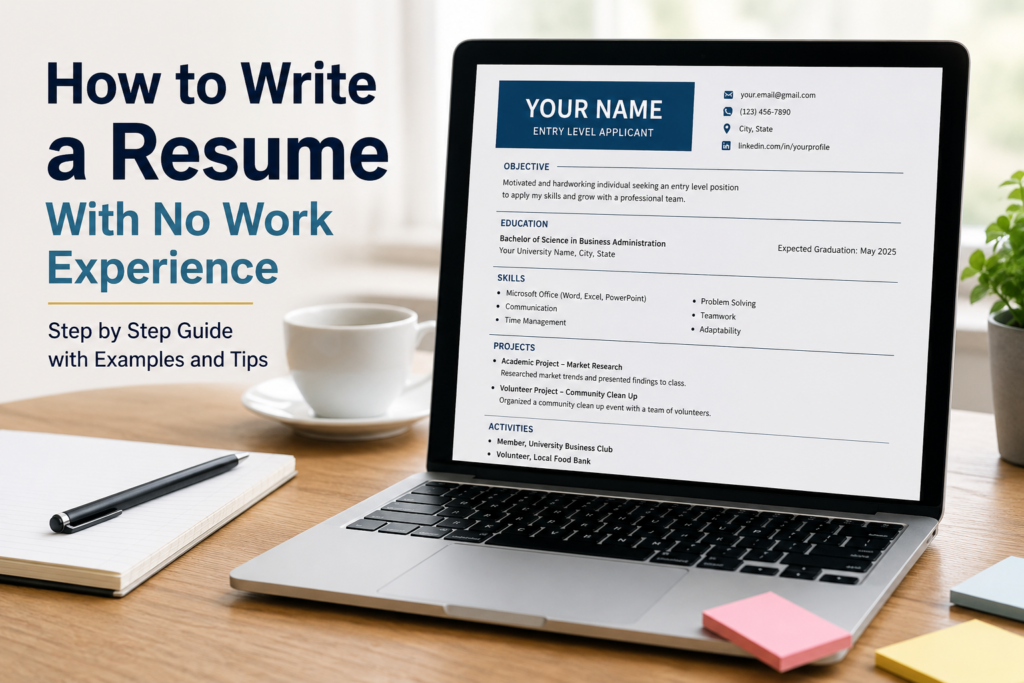
Start With Your Contact Information
The first part of your resume should contain your basic contact information. This section should be simple and easy to read.
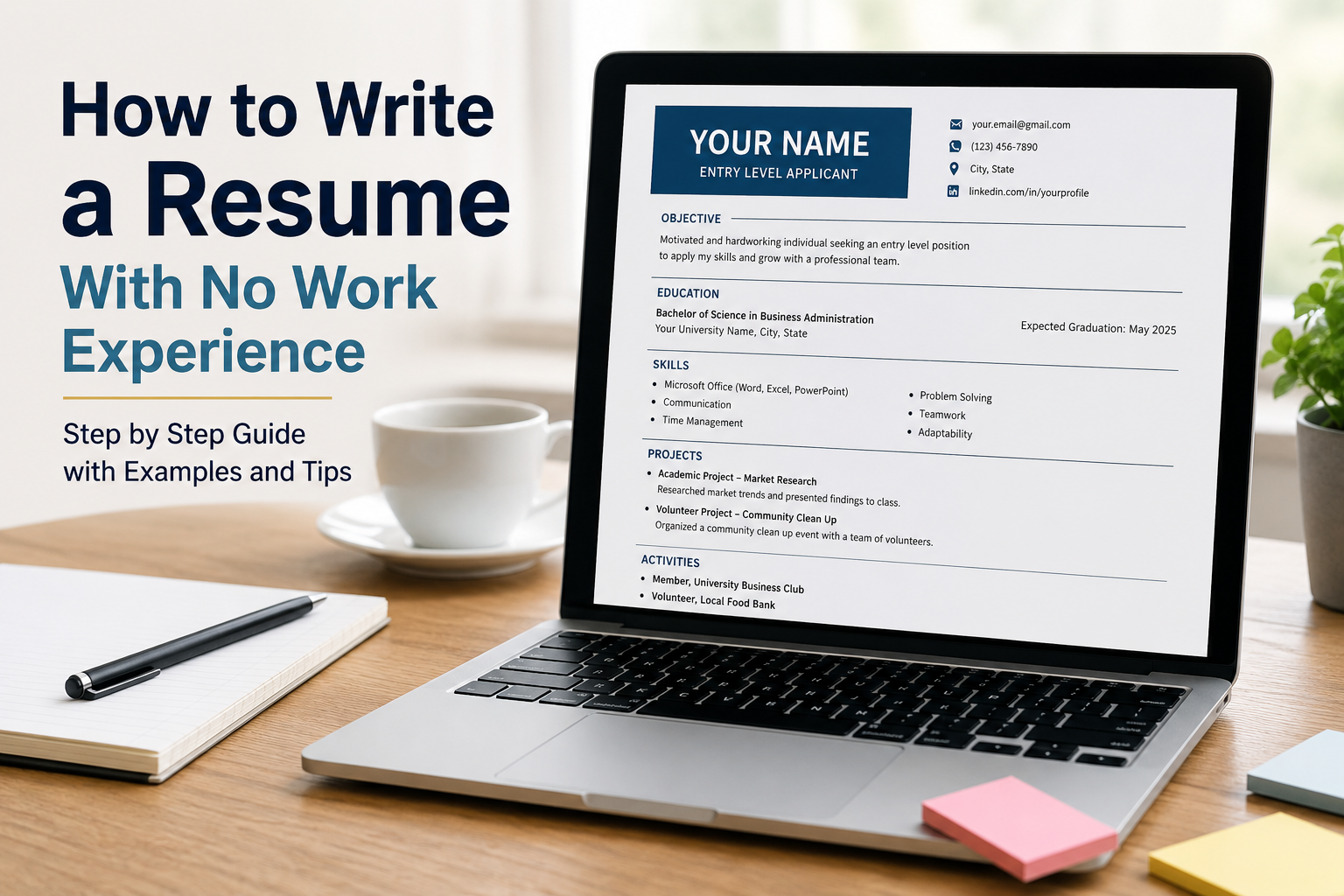
Include your full name, phone number, professional email address, city and country, and LinkedIn profile if you have one.
I recommend using a professional email address that contains your name. Avoid using an email address that looks like a nickname or contains unnecessary words. Your contact information should make it easy for an employer to contact you.
You do not need to include personal information such as your complete home address, national identification number, marital status, or other unnecessary details unless an employer specifically asks for them.
Write a Strong Resume Objective
When you have no work experience, a resume objective can be very useful. It gives you an opportunity to explain what type of position you want and what you can offer.
A good resume objective should be short and specific. Instead of writing something general like “I want a job in a good company,” explain your career interest and relevant strengths.
For example:
“Motivated recent graduate seeking an entry level marketing position where I can use my communication, research, and social media skills while developing professional experience.”
This type of objective tells the employer what you want and what skills you can bring to the workplace.
In my view, your resume objective should match the job you are applying for. If you are applying for a customer service position, mention communication and problem solving skills. If you are applying for an office position, you can highlight organization, computer skills, and attention to detail.
Highlight Your Education
Education can become one of the most important sections when you have no work experience.
Start with your most recent qualification and work backward. Include your degree, diploma, school or university name, location, and graduation year or expected graduation year.
You can also mention relevant subjects, academic achievements, scholarships, or coursework if they are related to the job.
For example, if you are applying for an entry level accounting position, subjects such as financial accounting, business mathematics, and economics may be worth mentioning.
Do not make your education section unnecessarily long. The goal is to show the employer what you have studied and how it relates to the position.
Focus on Your Skills
Skills are extremely important in a resume with no work experience. Employers want to know what you can actually do.
Make a list of skills that are relevant to the position. These can include technical skills and soft skills.
Technical skills may include Microsoft Word, Excel, PowerPoint, graphic design, basic coding, data entry, social media management, research, or other software skills.
Soft skills may include communication, teamwork, time management, problem solving, organization, adaptability, and attention to detail.
However, I recommend avoiding a huge list of random skills. Choose skills that you genuinely have and that match the job description.
For example, if a company is looking for someone who can communicate with customers and manage basic computer tasks, your resume could highlight communication, customer service, Microsoft Office, organization, and problem solving.
Add Academic Projects
Academic projects are often overlooked by students, but they can be valuable when creating a resume with no professional experience.
Think about assignments, presentations, research projects, group projects, or practical work you completed during your education.
For example, a business student might include a market research project. A computer science student might mention a website or software project. A design student could include a portfolio project.
Explain what you did rather than simply writing the project title.
For example:
“Completed a market research project by collecting customer information, analyzing competitors, and presenting findings to a class.”
This gives the employer evidence that you have practical skills.
Include Volunteer Experience
Volunteer work can also strengthen your resume. You do not need to be paid to gain useful experience.
If you helped organize a school event, participated in a community project, assisted an organization, or worked with a student group, you can include those activities.
Volunteer experience can demonstrate teamwork, communication, responsibility, leadership, and organization.
For example:
“Helped organize a community event by coordinating volunteers, preparing materials, and communicating with participants.”
This sounds much stronger than simply writing “Volunteer.”
Mention Internships and Training
Even if you have never had a full time job, you may have completed an internship, training program, workshop, or short course.
These experiences can be included on your resume if they are relevant to the job.
For example, someone applying for a digital marketing position could mention a digital marketing course where they learned search engine optimization, content writing, social media marketing, and basic analytics.
If you completed an online course and received a certificate, you can add it under a certifications section.
Use Achievements to Show Your Potential
Achievements can make a beginner resume more interesting.
Think about academic awards, competitions, leadership positions, scholarships, certificates, sports achievements, or other accomplishments.
You do not need to have won a national competition. Smaller achievements can also demonstrate useful qualities.
For example, being selected as a class representative can show leadership and communication. Completing a difficult project can show dedication. Winning a school competition can demonstrate determination.
The important thing is to choose achievements that support your professional goals.
Add a Projects Section
If you have limited experience, creating a separate projects section can be a smart choice.
Projects give you a way to demonstrate practical knowledge. They can be academic, personal, freelance, or volunteer based.
For example, if you want a job in content writing, you could mention a personal blog where you practice writing articles. If you want to work in web development, you could mention a website you created.
For each project, briefly explain the project, your role, the tools you used, and the result.
This helps employers see that you are not only learning but also applying your knowledge.
Keep Your Resume Simple
When creating a resume for the first time, it can be tempting to use many colors, graphics, icons, and complicated designs. I personally believe a simple resume is usually better.
Use clear headings, readable fonts, consistent spacing, and a clean layout.
Your resume should be easy for a recruiter to scan quickly. Important information should be easy to find.
For most entry level positions, one page is usually enough if you have limited experience.
Do not add unnecessary information just to make the resume longer. Quality is more important than quantity.
Use Keywords From the Job Description
One of the most useful resume writing tips is to pay attention to the job description.
Employers often use specific keywords when describing the skills and qualifications they want. If you genuinely have those skills, use relevant terms naturally in your resume.
For example, if the job description mentions “customer service,” “Microsoft Excel,” “communication,” and “problem solving,” you can include those terms in the appropriate sections of your resume if they accurately describe your abilities.
This can also make your resume more relevant to applicant tracking systems used by some employers.
However, never add skills simply because they appear in a job advertisement. Your resume should always be truthful.
Write Clear and Strong Descriptions
The language you use can make a big difference.
Instead of writing vague statements, describe actions and results whenever possible.
For example, instead of saying:
“Worked on a college project.”
You could write:
“Collaborated with three classmates to research customer preferences and presented the findings using Microsoft PowerPoint.”
The second version provides more useful information and demonstrates teamwork, research, and presentation skills.
Try to use clear action words such as created, organized, researched, prepared, managed, designed, presented, analyzed, assisted, and developed.
Check Your Resume Carefully
Before sending your resume, read it several times.
Check spelling, grammar, punctuation, dates, phone numbers, email addresses, and formatting.
A small spelling mistake can make a resume look less professional. I recommend reading the resume slowly rather than quickly scanning it.
You can also ask a teacher, friend, mentor, or another trusted person to review it.
Make sure your formatting remains consistent throughout the document. Your headings, font sizes, spacing, and alignment should look professional.
Avoid Common Beginner Resume Mistakes
One common mistake is trying to hide the fact that you have no work experience. There is no need to do this.
Instead, focus on your strengths.
Another mistake is adding false information. Never create fake jobs or responsibilities just to make your resume look better. Employers may verify information, and honesty is always the safer approach.
Avoid writing long paragraphs. Recruiters generally want to find important information quickly.
You should also avoid sending the exact same resume for every job. Adjust your objective, skills, projects, and other relevant sections according to the position.
Final Thoughts
Learning how to write a resume with no work experience is mainly about presenting your existing knowledge in the right way. You may not have a professional employment history yet, but you still have skills, education, projects, achievements, and experiences that can demonstrate your potential.
In my opinion, the best beginner resume is simple, honest, focused, and relevant to the job. Start with clear contact information, write a strong resume objective, highlight your education, and give special attention to your skills and projects. Add volunteer work, certifications, achievements, and other relevant activities when they strengthen your application.
Most importantly, do not think that having no work experience means you have nothing to offer. Everyone starts somewhere. A well written entry level resume can help you communicate your strengths and give an employer a reason to consider you.
Your first resume does not need to be perfect. As you gain internships, projects, training, and professional experience, you can continue improving it. The important thing is to start with an honest and professional resume that represents what you can do today while showing your willingness to learn and grow.